Does AI use the right law for the right jurisdiction?
Legal AI Reliability and Jurisdictional Reasoning Study · Caribbean and US arms
Support the research · All research programs
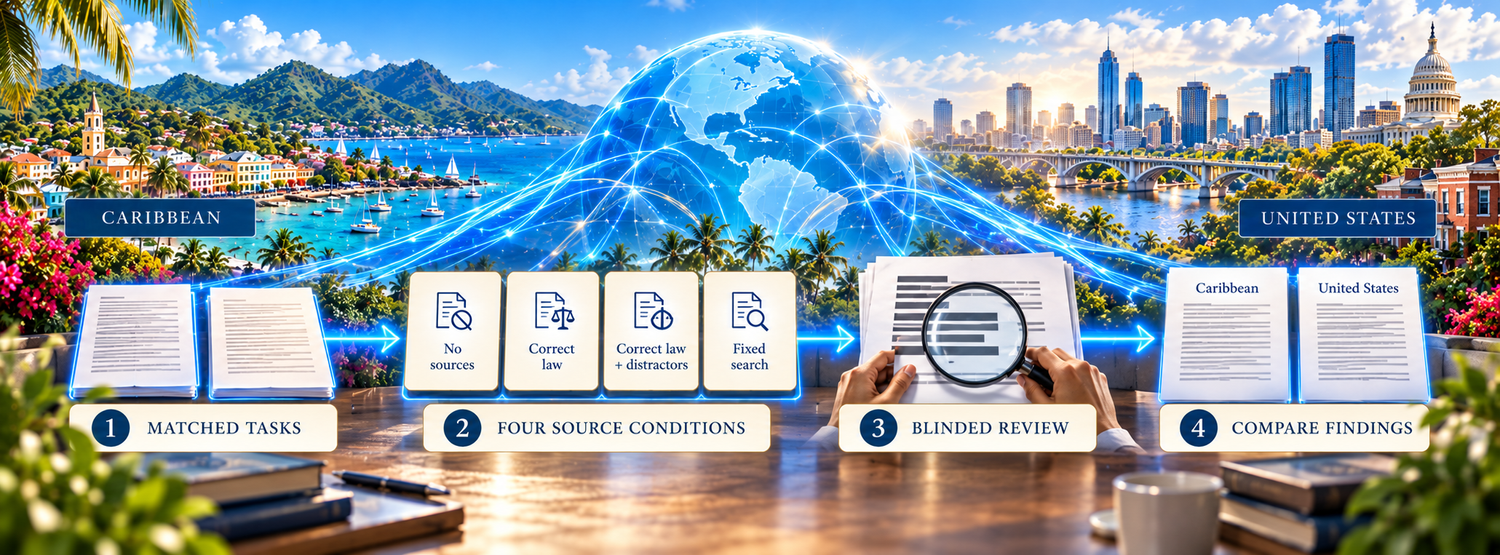
Preparations are underway
Study preparations are underway across a connected Caribbean and US research program. Work is focused on refining the design, legal sources, task development, expert review arrangements, and evaluation infrastructure.
Two arms with a shared research core
Three jurisdictions
Jamaica, Barbados, and Trinidad and Tobago. Employment law and civil/commercial procedure.
State and federal law
North Carolina, New York, and California, with applicable federal law and a federal immigration module.
Comparable legal questions
Align employment and procedure tasks, legal dates, model versions, and review standards.
Evidence across legal systems
Understand jurisdictional reasoning, source use, serious errors, and uncertainty.
US study scope
The US arm extends the design to North Carolina, New York, and California, incorporating applicable federal law. It covers employment, civil and commercial procedure, housing, debt, public benefits, and criminal law, with a separate federal immigration module. These selected jurisdictions and subjects do not represent every US legal question.
How the arms connect
Employment law and civil/commercial procedure form the direct comparison between the Caribbean and US arms. The design aligns question types, legal dates, difficulty, answer instructions, model versions, and legal review standards, while specialists retain each jurisdiction’s actual law. The additional US subjects broaden the research and will be reported separately from the matched comparison.
Both arms examine answers with no supplied sources, verified correct law, correct law plus credible but inapplicable material, and results from a fixed search tool. This helps distinguish applying the right law from being misled by the wrong jurisdiction or failing to retrieve a necessary authority.
The shared design asks whether supplying correct law reduces serious errors and improves substantive correctness. Cross-region comparisons will be made where versions and conditions can be aligned, with uncertainty and matching limitations stated. They will not establish that geography or model training exposure caused a difference.
The question
We propose to examine whether AI-generated legal answers select the correct jurisdiction, rely on supporting authorities, respect the relevant legal date, and identify missing facts. We would also examine whether access to appropriate legal sources improves reliability.
Caribbean and US jurisdictions
Caribbean study scope
Jamaica, Barbados, and Trinidad and Tobago, with an initial focus on employment law and civil and commercial procedure. Both arms use synthetic scenarios rather than client files.
Shared study design for both arms
Synthetic legal question
Caribbean and US scenarios with a specified jurisdiction, legal date, and set of facts.
AI answers
Both arms use no sources, correct law, distractors, and fixed search results.
Blinded expert review
Correct jurisdiction · supporting citations · relevant date · missing facts.
Public evidence
Findings from both arms and matched comparisons, with methods and limitations.
Local legal expertise would verify sources and assessment materials. AI answers would be compared under different source-access conditions and graded without reviewers knowing which model produced them. Methods, uncertainty, and limitations would accompany reported results.
Roadmap for the Caribbean and US arms
Develop
Refine the Caribbean and US protocols, recruit local expertise, and verify legal sources.
Review
Prepare Caribbean and US scenarios and obtain local legal and methods review.
Test
Test both arms under aligned conditions and assess answers through blinded legal review.
Share
Publish findings for both arms and eligible matched comparisons, with limitations.
Research integrity
Qualified legal specialists will verify sources, dates, reference answers, and jurisdiction-specific assessment criteria. Model answers will undergo blinded legal review, with material disagreements resolved by specialists. Public reports will distinguish substantive correctness, serious errors, citation support, and uncertainty. Protected questions and answer keys remain controlled.
What we intend to share
We plan to share a methods report, aggregate findings, limitations, and accessible explanations following review and release approval. Protected test materials and restricted source texts will remain controlled.
What the study can tell us
The research is intended to produce evidence about performance under documented conditions. It will not provide legal advice or certify a model as safe for legal practice.
Related Language research
The Foundation also prepares an independent Caribbean and West African AI Translation Evaluation. It assesses meaning preservation across selected language varieties. Legal and translation assessments use distinct tasks and measures.